


In the fifth episode, Nicholas Saraceno walks through why natural colors, upcycled ingredients, and sustainable sourcing have become inseparable from consumer trust, and what that shift means for manufacturers deciding where to invest first.
In the fifth episode, Nicholas Saraceno walks through why natural colors, upcycled ingredients, and sustainable sourcing have become inseparable from consumer trust, and what that shift means for manufacturers deciding where to invest first.

Matts Johansen explains why traceability, not just quotas, may be the real safeguard against supply chain "shortcuts" as omega-3 sourcing comes under pressure, along with why he sees marine-protected areas as a long-term ally for industry.
Matts Johansen, CEO of Aker BioMarine, says the coming shortage isn't about price, but about supply disappearing entirely.

Gelita's North America marketing communications manager breaks down how rising GLP-1 usage is accelerating demand for nutrient-dense, portion-smart products, the tradeoffs between collagen and complete proteins in bar formulations, and what responsible claims substantiation looks like for collagen peptides.

David Foreman, Hank Ramsey, and Irfan Qureshi close out their Peer Exchange with a candid look at organic certification, global sourcing, tariffs, and the innovations shaping the future of the nutraceutical industry.
David Foreman, Hank Ramsey, and Irfan Qureshi dig into the technical side of dosage design—exploring how solubility, pH, and stability determine whether an ingredient calls for immediate, delayed, or sustained release.
Leading industry professionals David Foreman, Hank Ramsey, and Irfan Qureshi unpack why gummies, soft chews, powders, and shots are reshaping supplement formulation—and what it really takes to get an alternative delivery format right.
What are the main differences between using plant-based or animal-based capsules? This conversation details the decision-making behind this choice and the potentials costs and benefits of that choice.
Industry veterans discuss the decision-making behind choosing between capsules or tablets when formulating nutraceuticals.

NPA's Daniel Fabricant, PhD, draws on his time as former director of FDA's Division of Dietary Supplement Programs to explain the agency's regulatory mindset, then lays out the association's near-term priorities.

Stanford's Michael Fredericson, MD, FACSM, unpacks creatine's emerging role in memory and cognition and why the basics still matter most for healthy aging.
Stanford's Michael Fredericson, MD, explains creatine's role in longevity and muscle strength, highlighting why creatine can be especially relevant for women.

In the fourth episode, Nicholas Saraceno unpacks why negative media coverage of omega-3 research doesn't always tell the full story, and what finished product manufacturers and consumers alike should understand about reading past a headline to the actual study design.
NPA's president and CEO explains how the organization decides when to challenge industry-critical research, breaks down what he sees as “flawed” methodology in a recent glucosamine-Alzheimer's study, and weighs in on a lawsuit that could reshape how supplement health claims are made.

As a new lawsuit challenges FDA's food-only interpretation of authoritative health claims, Steve Mister, president and CEO of CRN, discusses its own First Amendment case over New York's age restrictions and how Sergeant Searchlight fits into serious policy advocacy.
The association’s president and CEO explains the strategy behind Sergeant Searchlight, and why voluntary product databases fall short of the mandatory registry the industry has pursued for 6 years.

Susan Kleiner, PhD, explains how evidence favors creatine monohydrate, while newer forms lack superior outcomes; major gaps remain in data for children, gummies, fertility, and pregnancy.
Susan Kleiner, PhD, explains how creatine may support women through hormonal transitions, aiding mood, cognition, strength, and recovery.
Susan Kleiner, PhD, discusses gaps in creatine research for women, from menstrual cycle control to lower baseline stores and variable performance benefits.

Sponsored
What formulators should look for when selecting standardized botanical ingredients for women's wellness products.
In the third episode, Nicholas Saraceno discusses why male hair thinning is increasingly being understood as a multifactorial, systemic health issue rather than a purely cosmetic one, and what that shift means for how the supplement industry formulates and substantiates products for men.

Harry Rice breaks down GOED's comments to FDA on safety-based ingredient standards, and explains what recent headline-grabbing studies on omega-3s and cognitive health actually do and don't tell us.
From El Niño disruptions to the Peruvian anchovy fishery to a forthcoming expert panel recommendation on EPA and DHA, GOED's Harry Rice breaks down what's shaping the omega-3 category in 2026.
Sponsored
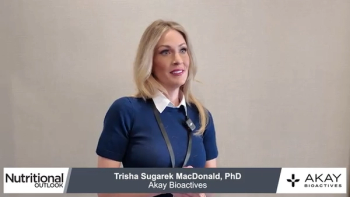
Trisha Sugarek MacDonald, PhD, reveals a clinically substantiated plant-based ingredient that adapts to women's hormonal needs across every life stage.

Nutraceutical industry veteran, Lauren Clardy, discusses her 25-year journey, the biological shift in weight management, and why the intersection of traditional botanical medicine and modern delivery technologies excites her.

Nutrafol's chief medical advisor Heather Woolery-Lloyd, MD, explains how DHT, stress, nutrition, and inflammation all shape follicle function in men.

Sponsored
Biova’s Amanda Jepson shares what the women's health industry is getting wrong about aging and highlights what brands must do differently to keep up.

Mike DeMarco on why building general activity comes before any intense training program, and how a simple phone app often delivers the wake-up call.
Mike DeMarco, wellness coach with MJH Life Sciences, has built his foundation around protein, creatine, and a multivitamin for years, but it's the mindset reinforcement that keeps him coming back to them.
From cutting volume to building a race-specific running base, Mike DeMarco breaks down how he restructured his training for HYROX, and why the lessons apply well beyond the race format.