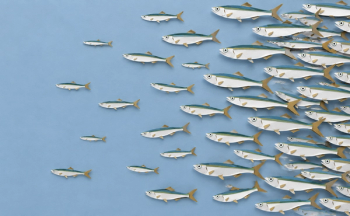
With Peru's anchovy fishery opening its 2026 season with its lowest quota in a decade, Matts Johansen argues that aquaculture's growing appetite for omega-3s, not just El Niño, is what should actually be keeping supplement brands up at night.
Matts Johansen, CEO of Aker BioMarine, says the coming shortage isn't about price, but about supply disappearing entirely.
In this video interview, Nutritional Outlook Senior Editor Nicholas Saraceno speaks with Matts Johansen, CEO of Aker BioMarine, about the growing strain on the global omega-3 supply chain and why he believes the nutraceutical industry is underestimating the scale of the problem.
Johansen begins by addressing krill's Antarctic sourcing, noting that the fishery draws from deep, pristine currents largely insulated from El Niño patterns affecting Peru's anchovy fishery. With harvest limited to roughly 1% of total biomass, he describes krill as one of the most sustainable and underdeveloped fisheries in the world, with significant room to scale.
The conversation then shifts to a broader structural issue: omega-3 demand already outpaces supply, independent of any single climate event. Johansen points to aquaculture, which consumes 70–80% of global omega-3 production, as the real driver of scarcity. Growing 4–5% annually and able to outbid human-market buyers, aquaculture producers have spent the past six to twelve months aggressively securing omega-3 sources in Peru, Turkey, and elsewhere, he says, while the nutraceutical sector has been slower to react.
Johansen warns that Peru's fishery, already producing at roughly 10% of typical output for the first half of 2026, could see a near-total loss of its second season, potentially leaving the industry with as little as 5% of normal supply. He argues the resulting risk isn't higher prices but consumers losing access altogether and abandoning the category for other health strategies.
He closes by urging brands to diversify now across algae, krill, and other alternative sources before fish oil supply is disrupted, cautioning that the depleted inventory buffers that softened past shortages no longer exist. His central message: the data already shows what's coming, and the brands that act early will be the ones that retain their customers.
A transcript of their conversation can be found below.
Nicholas Saraceno: Ladies and gentlemen, welcome to another edition of the Nutritional Outlook video series. I am Nico Saraceno, senior editor of Nutritional Outlook magazine, and today I am joined by none other than Matts Johansen. He is the CEO of Aker BioMarine. We have a lot to get into today, Matts, but thank you so much for taking the time today. I really do appreciate it.
Matts Johansen: Thank you. It's me who appreciates being here.
Saraceno: For sure, for sure. So of course, for those of you watching who may not be as aware, Aker BioMarine sources krill from Antarctica. While much of the omega-3 industry depends on the Peruvian anchovy fishery, which actually just opened its 2026 six season with its lowest quota in about a decade. Does krill's separate supply chain actually insulate the category from El Niño-driven disruption? Obviously, that's top of mind. Or would you say Antarctic waters are facing their own version of the same kind of climate pressures?
Johansen: So no signs of El Niño or anything like that in Antarctica. The currents come from the depth of Antarctica, 3000 m coming up and then going north. So it's kind of coming pristine water there. And it's one of those few fisheries that still have a lot of potential to be developed. The quota is very restrictive, so you can only catch 1% of the biomass. And as a result, it's deemed as actually the most sustainable fishery in the world, but there's a lot of untaken quota.
You can continue to increase this fishery for quite some while, and it can be a viable source for both marine proteins and omega-3s in this kind of supply chain distress that we're seeing right now.
Saraceno: Certainly, and I feel many would make that argument that diversification could be considered one of several key defenses against the supply chain volatility that we're experiencing. Beyond sourcing from, say, a different species and region, in your opinion, what does real diversification look like in practice? Is it about the geographic spread, is it related to the harvesting method, or is it tied to something else entirely? How do you see that?
Johansen: First of all, I think it's a fundamental challenge because there is more demand than supply of omega-3, El Niño or not, and it's driven from the aquaculture industry. The aquaculture industry is growing 4 or 5% per year, and they are absolutely dependent on omega-3 for their fish or their shrimp to survive. And they're using not a lot of it in the diet, right? They can actually pay a lot, much more than human markets, which is quite surprising.
There's a fundamental challenge of having enough omega-3s to supply the growing demands, both on the human side and aquaculture. Almost 70 to 80% of the total omega-3 production in the world taken is by aquaculture. Sixteen percent goes into the nutraceutical segment. I think the challenge we're facing in the nutraceutical industry is that the aquaculture industry is already on top of this challenge. They've been on top of it for the last 6-12 months, and are making moves.
They're moving into Peru, buying the human-grade omega-3 sources that we are depending on for our industry. They are going to Turkey. They're going to different type of regions of the world securing the access, and I would say our industry hasn't woken up to the severity of the situation yet, and might be taken on surprise now because it's not going to be that omega-3 will be much more expensive than today. The main problem is that there will be no supply.
Take the Peruvian fishery. As you mentioned, just this year, they are producing 10% of what they normally do for the first half of the year. The question is, what's going to happen the second season? Now, this is before El Niño is kind of happening. That's the first half '26.
Second half, there might not be any catches at all, which means we will be left by probably 5% of the supply than what we normally have. That means that brands out there, they have to diversify their portfolio of sources of omega-3: algae, krill, whatever different sources they can have to make sure once their fish oil supply stops, because it will. They will have to have some alternatives to put in front of the consumers, because the problem is that if you don't have those alternatives available, most consumers will walk away and do something else. They may sign up for the gym, start eating healthier, and get some other strategies for their health, and we will lose those consumers forever.
Saraceno: It’s interesting too, because you mentioned, obviously, the aquacultural field has been on top of this for the past 6-12 months, but what do you think? Is there anything specific that it'll take for our industry in terms of nutraceuticals to kind of wake up now rather than later? What's that thing pushing them do you think that's going to help push the needle on that?
Johansen: I think this crisis has happened before. There wasn't anything new, 2 or 3 years ago. We just made it because there was enough inventory in the supply chain to kind of keep things flowing through the crisis. But the problem is that those inventories hasn't been built up since then. And I think people just think that probably it's going to sort itself out, there’s nothing to worry about.
It sorted itself out in the past. I don't think it will. And I think those brands that are proactive now and make strategies for a situation where actually supply will be disrupted—they will be the ones that win. They will be the ones catching the consumers out there. I think this podcast can help, but we are starting to educate, put the numbers out. Just look at the data. Don't take our word for it, just look at the data. How much are we producing versus what we usually produce? How much is going to human versus aquaculture? Just look at that picture, and I think once you see the data, everybody will understand what is about to happen.