

FDA today released its long-awaited revised new dietary ingredient (NDI) draft guidance with two major changes the dietary supplement industry will likely hail as good news.
FDA today released its long-awaited revised new dietary ingredient (NDI) draft guidance with two major changes the dietary supplement industry will likely hail as good news.

The USDA now has two years to hammer out details for implementing the federal GMO-disclosure law.

The Natural Products Association has launched a new database of more than 400 dietary supplement warning letters from FDA, as well as other regulatory enforcement actions taken since 2008.

From cat scans to particle structure, ingredient suppliers are using advanced methods to help food formulators cut sodium.

Fiber suppliers at this year’s Institute of Food Technologists Annual Meeting & Food Expo told Nutritional Outlook that while they are confident FDA will eventually consider their ingredients to be dietary fibers, the path to FDA approval is unclear.

Rimfrost’s Sublime PL60 krill oil, which debuted last fall, features a phospholipid content of up to 60% and high levels of choline, astaxanthin, and omega-3 DHA and EPA.

The FTC accused Herbalife of misleading consumers by suggesting those consumers could earn significant income by selling Herbalife products when in fact most did not.

President Obama is expected to sign the legislation, which would nullify Vermont’s mandatory GMO-labeling law.

The controversial bill, which would allow food companies to direct consumers online for GMO disclosures, passed in the Senate last night by a 63–30 margin.

Companies who choose to invest in in-house manufacturing may see unique dividends, says one equipment supplier.

The Council for Responsible Nutrition’s annual events will take place from October 26–29 at the Ritz-Carlton, Laguna Niguel (Dana Point, CA).

Underwriters Laboratories and the Council for Responsible Nutrition expect to launch the new online registry by the end of 2016, with beta testing planned for the coming months.

The bill would have required supplement manufacturers and retailers operating in Puerto Rico pay higher fees and submit additional product information.

Market researcher Euromonitor International took a look at how “Brexit” could negatively affect the consumer packaged foods industry.
If the bill were to pass, companies could disclose GMO ingredients through on-package text, symbols, or digital codes that direct consumers to more information online.

Algae Life Sciences recently announced it had 239 “FDA-allowed” structure-function claims for its AstaZine astaxanthin ingredient. But its competitor, AstaReal, challenges the significance of these claims.

More than 60 supplement industry executives sat down with members of the U.S. Congress last week to discuss pressing issues facing the industry.

FDA’s new draft guidance seeks to reduce daily sodium intake to 2300 mg per person over the course of 10 years.

FDA says KIND can continue to use the term “healthy” on its packaging because it is an expression of “corporate philosophy” and not a health claim. Will other companies follow suit?

The new health claim applies to foods containing at least 0.5 grams of EPA and DHA combined.

The company is now certified to UL’s National Brand Certification Program (NBCP).
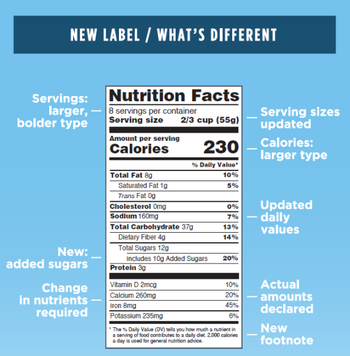
Manufacturers have up to two years to comply with the new label for food and beverage packaging.

Germany-based Erdman Analytics is now performing testing for all three legs of NSF’s dietary supplement testing and certification programs: Good Manufacturing Practices (GMPs) registration, NSF dietary supplement certification, and NSF Certified for Sport.

New SPINS data shared by the Hemp Industries Association estimates the market for hemp food, supplement, and body care products grew by 10.4% last year.
Called PhytoProof, the new seal “signifies that the botanical extract inside comes from Euromed and is therefore a guarantee that it’s the real deal, the one that can be 100% trusted to deliver what it promises,” the firm says.

Algae Life Sciences Inc., supplier of AstaZine astaxanthin, says FDA had no objections to 239 structure-function claims the supplier recently submitted.

LactoSpore is a hardy, shelf-stable probiotic strain suited for use in a variety of foods and beverages, including baked goods and coffee.

Do new technologies and blending practices mean stevia and monk fruit are moving away from their natural roots?


The Council for Responsible Nutrition, the Natural Products Association, and many others submitted recommendations for how FDA should regulate use of the term “natural.”