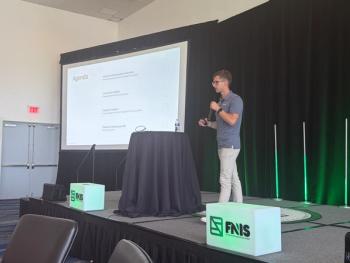
At the Future Nutra Innovation Summit, PLT Health's Steve Fink discusses joint, cognitive, and longevity nutrition explaining why "experiential longevity" is reshaping formulation strategy.
At SupplySide Global 2025, Florencia Moreno Torres, global marketing manager for Rousselot, Inc, discusses Nextida GC and its effect on boosting GLP-1 secretion.
Live from SupplySide Global 2025, Nutritional Outlook Associate Editor Erin McEvoy interviews Rousselot’s Florencia Moreno Torres who explains how the collagen peptide Nextida GC, has been shown to boost GLP-1 secretion, support glucose control, and help reduce post-meal sugar spikes by up to 43%. She also discusses future innovations in collagen peptides.
Transcript
Erin McEvoy: Hi everyone. I'm here with Florencia Moreno at Rousselot and we're here to talk about Nextida GC. So can you describe what research has shown about the relationship between Nextida GC and GLP-1secretion?
Florencia Moreno Torres: Yes, of course. Well, actually, we have run pre-clinical and clinical tests at Rousselot, where we have found out that when taking Nextida GC after a meal, there is an increase on the secretion of GLP-1, which is a hormone together with GIP, so these two hormones are very highly related with glucose control and feeling of fullness and regulation of appetite.
McEvoy: So does this have any impact on weight management?
Moreno Torres: Well, I think yes. Indirectly it does, but I think it's very important to understand the power of increasing or having this boost in GLP-1, because what it does, pretty much is that if you take it before a meal, it helps lowering down your sugar spikes. So after we eat, it's completely normal to have a sugar spike. That's just a physiological response. But we have researched that when taking Nextida GC at five grams or 10 grams before a meal, this sugar spike is lower by up to 43% so that means that then the sugar crash that follows is way less. So the problem with these sugar crashes is that the deeper they are, then they come with secondary effects, like fatigue, like cravings, like really wanting to eat more of these sugary things, it leads you to overeating. So then, of course, with issues with weight management, and by, for example, taking Nextida, lowering this glucose spike, then we are aiding, we are supporting to avoid these crashes, this overeating, these cravings, and in that way, helping as well in weight management.
McEvoy: So what makes Nextida stand out from other collagen peptides?
Moreno Torres: Great question. Well, actually, what we did at Rousselot is that we work with a library of candidates. These candidates actually are part of what we call the Nextida platform. So we pretty much took the collagen protein and we did different ways of processing. So then this same molecule of collagen gave us different candidates. So it's still collagen peptides, but it has different compositions of dipeptides and tripeptides. So what we did is that we took this library of 16, we tested them in vitro to see how they influence the GLP-1 secretion. And then we saw, I believe it was candidate 16, that it pretty much by almost tenfold increase the GLP-1 boosting. So then we could clearly see that this effect in GLP-1 increase. It's not the same for all collagen peptides, because we compare it with more than 10 candidates. And it's definitely not just a protein effect, but it's very specific of Nextida GC.
McEvoy: So speaking of collagen peptides. What other innovations are you anticipating?
Moreno Torres: Well as part of also this Nextida platform that I was mentioning, and all these candidates, we are testing them for different mechanism of action, for different benefits. And actually, in a year from now, we are going to be launching as well our Nextida. So right now we have in the market Nextida GC. So the new, Nextidas are coming up, and I cannot tell you just yet what it’s going to be focused on, but we're working a lot, and very exciting things are coming.
McEvoy: All right. Thank you for sharing.
Moreno Torres: Thank you.