The palm phytonutrient supplier will show STGaia, TocoGaia, and PetGaia at the event and preview a planned research grant program.
The panel unpacks what "healthy aging" really means to consumers, why joint health hasn't grown as fast as expected, and why testosterone interest is suddenly resurging across age groups and genders.
This segment traces how consumers' more active role in monitoring their own health, through wearables and direct-to-consumer testing platforms, has pushed healthy aging from a reactive concern into a preventative mindset adopted earlier in life. Panelists note that healthy aging isn't a single audience but a collection of subcategories, and that legacy brands trying to serve "everyone" face a harder repositioning challenge than newer, more narrowly targeted entrants.
Joint health draws specific scrutiny as a category that hasn't grown proportionally with active nutrition's overall rise, despite an aging, increasingly active consumer base that would seem to need it. Rather than standalone turmeric or boswellia formulas, the panel describes a shift toward pairing classic joint ingredients with pomegranate extract, astaxanthin, or other multi-benefit botanicals, reflecting a broader industry recognition that health challenges rarely exist in isolation. Because joint and healthy-aging benefits often take time to become noticeable, panelists stress that formulators need to make the format and daily experience enjoyable enough to sustain long-term adherence.
The conversation's most animated turn comes on testosterone, which panelists describe as resurging after years of dormancy following the early "test booster" era. Drivers include wider access to advanced blood work, rising interest among women, and increased visibility of hormone replacement therapy through medical spas, alongside institutional attention such as military testosterone screening. Panelists caution that sports nutrition brands face real limits on verifiable testosterone claims, with meaningful hormonal change requiring interventions like testosterone replacement therapy or peptides rather than dietary supplements. Still, they see opportunity in companion products, comparing the dynamic to how GLP-1 medications have normalized self-injection and, in turn, opened consumer receptivity to complementary supplement categories addressing zinc, vitamin D, and magnesium status.
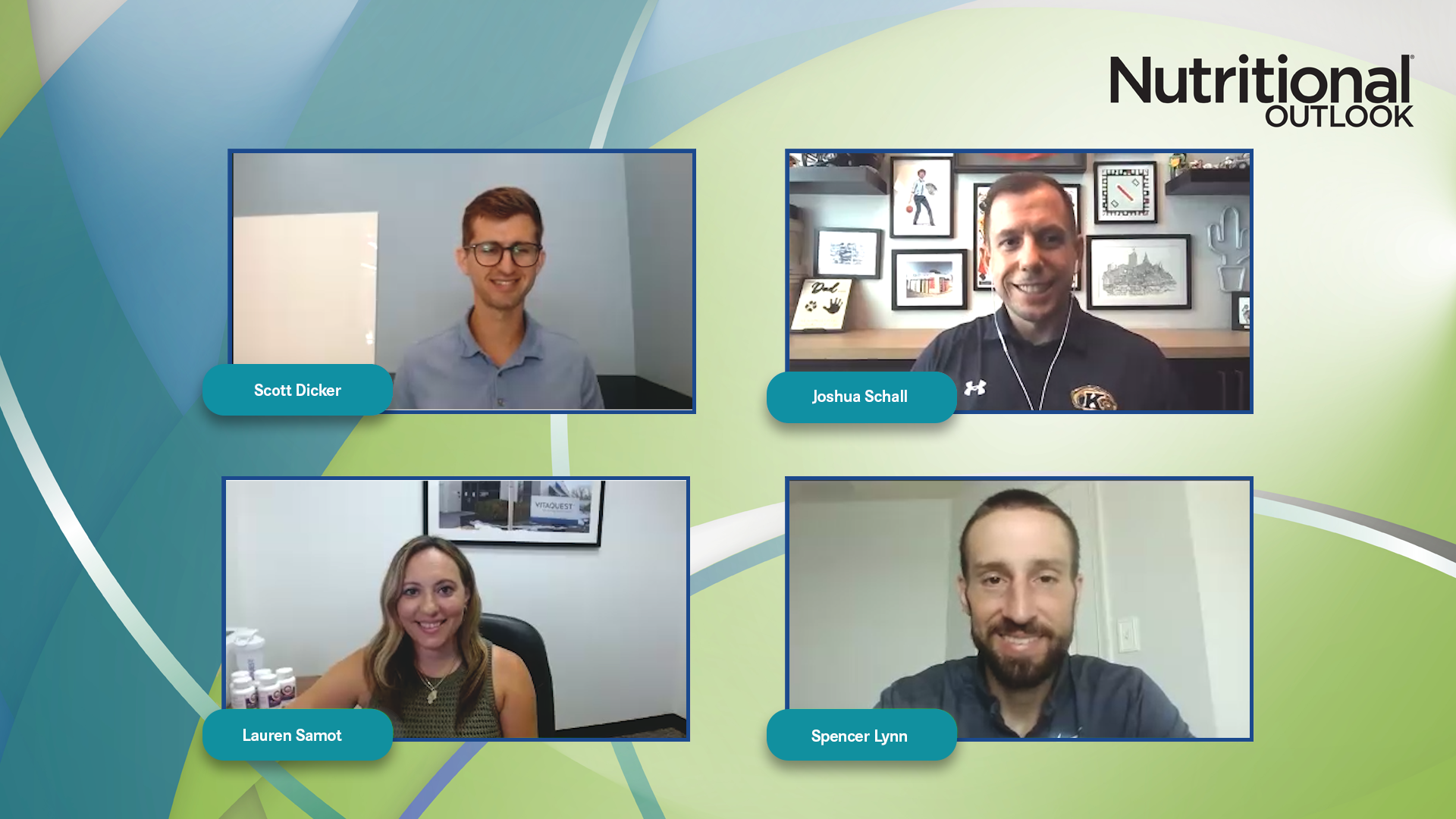
Participants include Scott Dicker, senior director, head of research and insights forSPINS; Joshua Schall, owner and president of J. Schall Consulting; Lauren Samot, commercial innovation director of Vitaquest International; and Spencer Lynn, vice president at PricePlow and Bevlab.
A transcript of their conversation can be found below.
Scott Dicker: Josh, we've been seeing how a lot of this drive from active nutrition is around healthy aging. People call it anti-aging, health span, or longevity, but it's all boiling down wanting to stay active later in life. What does it really look like? We could look at it from hormone health, to joint health, to muscle preservatives. What do you think is really sticking with consumers there?
Joshua Schall: It's an interesting evolution that's been going on. We could probably trace this back towards consumers taking a more active role in their health, and having the ability to
do that. Maybe that's wearables, maybe that's some of these more direct-to-consumer type health platforms that have predictive analytics and things like that. You're taking a more active role. I think because of that and the ability to do that earlier in life, you're trying to be more
preventative, and looking at things through maybe different lenses than you originally would, or maybe just earlier, and knowing, that maybe father time is still undefeated, but you have a little bit more control over the speed of that, and maybe you can impart a little bit of things to make that a better process.
If we're looking at brands or formulators, and they're looking at this market and they're saying, ‘oh, there's, a huge amount of opportunity here.’ You made a point earlier around, depending on if the brand is maybe a legacy or an incumbent brand, and they're coming at this as, ‘okay, we were everything to everyone, and now we want to be more focused,’ maybe then it's creating a system, a subline, putting some important parameters around what they believe is going to help. Maybe it's from the cellular level, or it's from whatever kind of approach they're taking—diving into that, and spending time with the consumer on there.
If you're a completely new brand coming in the market, you're really trying to make sure that you’re strategically and authentically aligning to that consumer segment throughout product, brand and everything like that, but it's really probably much easier for those brands to carve out how and what they want to achieve out of that, because there are multi-subcategories that go into healthy aging. It's not just 1 big, huge cohort that wants all the same things.
Dicker: I can make the argument that pretty much every category is a healthy aging category. We talk about brain health how used to be just for people trying to forget the senior moment, or not to forget the senior moment, but to not have that senior moment where they forget, and now, you know, it's for all ages, trying to be laser-focused. The same can be said about pretty much every category.
Lauren, I'm wondering what you're seeing on these categories, or what brands are looking to do for formulating around healthy aging. One topic that I seem to think is really ripe for growth is joint health. To piggyback on our first question, I never understand how active nutrition's the top growing category for so many years in a row, and then we're not seeing a big bump in joint health following it. From personal experience, I can tell you that's something important. So I'm curious, Lauren, if that's something that you're seeing, or maybe a different category for healthy aging.
Lauren Samot: So for joint health, we're still seeing some of our key classic ingredients, your turmerics, your boswellias, but we're really seeing it paired with is ingredients that address some of the other health challenges. There's never 1 health challenge that exists in a vacuum, so we might see Boswellian turmeric paired with things like pomegranate extract or astaxanthin, or things that have other benefits beyond your joint health. Maybe it supports your gut health, eye health, skin health, whatever it may be. Maybe it's mixed in with the addition of other superfoods that go beyond greens. Maybe you have your reds and your blues, and you're trying to diversify the diet, and you have your polyphenols that support gut health. It's just really important for brands to tell a story with their ingredients, because you have people playing the long game.
They’re not necessarily seeing an immediate benefit. Maybe with the joint health, they are. But with some of the anti-aging ingredients, they're just playing the long game, and they're not going to see a benefit right away. So you want to make the experience really enjoyable. Maybe it's the format that's enjoyable, maybe it's something that they look forward to drinking every day or taking every day, or maybe they notice an improvement in their skin health, or just an improvement in their gut health that kind of helps the other systems work together.
Dicker: You mentioned polyphenols, that's one that keeps popping up. A lot of them seem to be looking to address inflammation as one of the key ones. I'm going to throw out one more before we move on to the next topic. Really this year, we've seen a lot of growth in testosterone interest. It's almost what was once old is new again—we all remember those pest boosters back in the day. To Josh's point, we're seeing a lot of people get this advanced blood work.
They're checking their testosterone levels. We're seeing women interested in testosterone. I even saw recently how our military said they were going to be checking people for testosterone. We know med spas are offering hormone replacement therapy a lot more.
There's always that opportunity for both competitor and companion products to—now, this is just 1 hormone— but to a lot of them, we saw GLP-1s, berberine's been on a tear ever since it was dubbed nature's Ozempic. But then also, a lot of the companion products: protein, multivitamins to a lesser extent. Are you guys seeing anything or want to share anything about testosterone, when we talk about healthy aging specifically, but just in general?
Spencer Lynn: I think if we're being honest, from our space of sports nutrition, testosterone's a hard one to make verifiable claims around improving. I think the best we can really honestly hope to do is optimize testosterone. Other than that, you'd be getting more into things like peptides, TRT replacement, and things like that. That's a tough one to dive down that rabbit hole in our space of sports nutrition.
Schall: I do think from a consumer standpoint, the GLP-1s have almost gotten to this point that's conditioned consumers that there used to be, and I would probably include myself into this, is I don't like taking shots or needles. It's just not something I enjoy, but I think as more people get used to injecting themselves with things, that then puts that barrier down. And the dietary supplement market has to look at not necessarily trying to be a foe to these things, because I think, naturally, more people will try these products, because maybe the phobia is gone.
Then you move that into being a friend or a companion, and you have to think through a different lens in some of these products, instead of just going, oh, you know, bigger, stronger, faster, that used to be the marketing base case. It's kind of looking at it like, okay, from a hormonal standpoint, what are things that are going to be needed that's going to improve people that are going to naturally take TRT or anything like that, because the barriers to entry, or getting that stuff, is much lower than it ever had been.
Lynn: Much younger too.
Dicker: Absolutely. and 1 final thing before moving on. One easy trick to do is, if you start to ask some of the AI chatbots, what can I do to increase blank, and we say testosterone for this use case, the first thing it says is make sure you're not deficient in zinc, vitamin D, or magnesium, and so understand consumers are searching for that as well. Those are some highlights there.