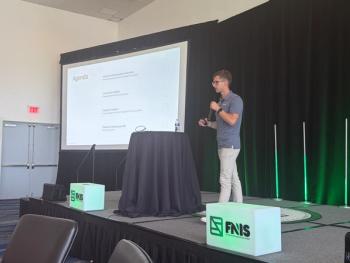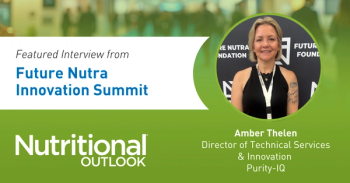
Live from the Future Nutra Innovation Summit, Amber Thelen, director of technical services and innovation at Purity-IQ discusses strain-level verification gaps, NMR testing, and viability PCR for probiotic testing.
In this interview from Natural Products Expo West, Kriti Chaudhary, Associate Director, Partnerships & Strategy Vedic Lifesciences discusses the importance of women-specific research.
Live from Natural Products Expo West 2026, Nutritional Outlook vistited the Vedic Lifesciences booth and spoke with Kriti Chaudhary, Associate Director, Partnerships & Strategy, about why women’s health remains under-researched and how the nutraceutical industry is beginning to close critical gaps.
Chaudhary highlights the importance of stage-specific, precision clinical trials for conditions like Polycystic Ovary Syndrome (PCOS), menopause, and vaginal health, and highlights the need for more women in leadership and as principal investigators to improve parity in research participation.
Transcript
Erin McEvoy: Hello everyone. I'm here with Kriti Chaudhary with Vedic Lifesciences. In honor of Women's Day coming up, we're going to talk about women's health in the industry. Thank you for joining us.
Kriti Chaudhary: Hi Erin, and thank you, Nutritional Outlook for covering this important topic. And happy to be here.
McEvoy: Thank you. So clinical research dedicated to women's health has been neglected until fairly recently, with new attentions to women's health and specific conditions, where have you seen an increase in visibility and closing of research gaps?
Chaudhary: So women's health, unfortunately, has been understudied, and so far, it remains the most under researched area in our industry today. However, things are evolving. Things are changing. And more brands are investing in research in the women's health space. More companies believe in proprietary science for women's health. There are areas in which people are running clinical trials, like PCOS, like menopause, like bacterial vaginosis, basically vaginal health, like fertility. So there are various aspects of a woman's life that need to be studied, and not every supplement is the same. You can't have the same study and the same supplement for men and women. So now brands are understanding this, and they have specific studies running for women, which is great, but we still have a long way to go.
McEvoy: Absolutely, I agree. So moving to the next question, as the industry moves from general supplementation to more stage specific support, like you were discussing, what is the biggest hurdle in developing evidence-based nutraceuticals for these specific conditions?
Chaudhary: Oh, god, yeah. I mean, it's not as easy as it sounds. Stage specific research needs proper quality by design. So when you're designing the protocol of a clinical trial, you need to be very careful to define the specific stage in which you're going to recruit the volunteer. So say, for example, if it's a women's health study, a woman in her pre menopause may not react the same way to the product compared to a woman in post menopause, right? So every stage in a woman's life will respond to the product very differently. So we always recommend to stratify the population in in terms of gender, of course, in terms of BMI, in terms of which stage the person is in their life cycle. All these points play important roles. It affects metabolic markers. It will affect all your questionnaires, your biomarkers, all your skills used in this study. So it really depends on the medical team to stratify the population in such a way that you select the right stage to run your women's health Study. So it's very crucial, and this must be done.
McEvoy: Absolutely. Those are important things to consider.
Chaudhary: And you know a person—say, for example, if you're running a weight management study, not everyone with the with a broad BMI might respond in the same way to the product. So you need to have a homogenous population that will respond better to your product. So it's important to understand how the product works in the body, and then select the right people for this study. And so this is also called precision clinical trials, or responder based clinical trial, in which you make sure that you get the best effect size in a homogenous population, thereby saving time and money.
McEvoy: So how have you seen women's leadership actually expand in the nutraceutical industry, and what new trends would you still like to see happen?
Chaudhary: Great question. I feel women bring so much to the table, right? It's been so many years women have been fighting for a seat at the table, but things are changing for the better. In our industry, I feel Women in Nutraceuticals is doing such a great job. We need more women at leadership positions, because women have a very different way of thinking. We bring a lot of creativity to the table. We bring scientific thoughts that believe in equality and parity in clinical trials. Yes, so I feel things are changing, but we definitely have a long way to go. And yes, there should be women as primary or principal investigators in clinical trials, because there are studies which show that whenever there are investigators as women in clinical trials, they tend to recruit more of women in the studies, thereby creating some level of parity. So we are still not at 50% but I think we'll get there, sooner than later.
McEvoy: All right, I hope so. Thank you so much for sharing your insights.
Chaudhary: You're welcome.