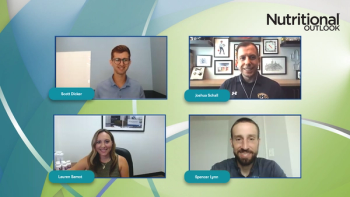
At the Future Nutra Innovation Summit, PLT Health's Steve Fink discusses joint, cognitive, and longevity nutrition explaining why "experiential longevity" is reshaping formulation strategy.
In this interview, Aleix Sala-Vila, PhD, shares more on his recent project involving data from global cohorts on links between omega-3 biomarkers and incident dementia.
Aleix Sala-Vila, PhD, is an associate scientist at the Fatty Acid Research Institute (FARI) and research fellow at Hospital del Mar Research Institute–cardiovascular risk and nutrition group, Barcelona, Spain.
In this interview, Sala-Vila shares details on his recent project involving data from more than a dozen global cohorts on omega-3 biomarkers and their relation to dementia.
For an in-depth examination of more of Sala-Vila’s research, especially on brain health, read more on
Transcript
Erin McEvoy: Could you share more about your current project examining data from global cohorts on omega-3 biomarkers and incident dementia?
Aleix Sala-Vila: So this is a work, it's a consortium which is called FORCE. It stands for Fatty Acids and Outcomes Research Consortium. It's led by Tufts University, and you know, the core figure is Dariush Mozaffarian. So FORCE has been having a really interesting way to approach science in the sense so they try to promote collaborations. So they try to contact cohorts with a specific fatty acid biomarker and a specific outcome. And once the cohorts are willing to collaborate, they share the same protocol for each cohort. So each cohort constructs or conducts the statistical analysis, and they shares the data, which is pulled together as a kind of meta analysis. And this is a really interesting approach, because thanks to this way to work, so FORCE has been publishing in relation, I don't know, omega-3 in relation, total mortality, the insulin, diabetes, atrial fibrillation, stroke, cardiovascular disease for sure. So plenty of nice papers appearing in top journals.
So I was lucky enough when FORCE said, “Okay, you could take the lead on the omega-3 biomarkers and incident dementia and incident Alzheimer's.” So we invited all the cohorts that we could find, or we could know. Some of them said, “Oh, this is interesting. We don't have data on incident dementia. We don't have data on Alzheimer's disease.” Some of them said, “Yeah, it's fine. We have this. We are willing to collaborate.” Some have said, “It's fine. We would like to collaborate. We don't have time.” So it could be either of these three. So this was, I don't know, maybe two years ago, three years ago. So we have been in touch with many different cohorts. So far, 19 cohorts agreed to collaborate, for free, that's important. Without any external funding. So they analyzed their own data, each cohort, using a specific and homogeneous protocol. They returned results to us, and we pulled the data. At this time, I can't disclose anything new. But I want to say that I submitted an abstract for the upcoming Alzheimer's Association Congress, which will be held in London this summer. So in in the meantime, I'm also writing the paper with a writing core group, and, well, I think I would say that I'm quite happy with the outcome. And I think that, well, it's something that, well, it can have some interest. I think that's the only thing I can say.