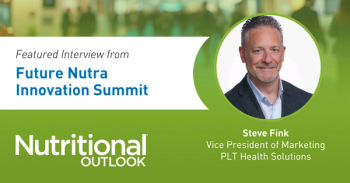
At the Future Nutra Innovation Summit, PLT Health's Steve Fink discusses joint, cognitive, and longevity nutrition explaining why "experiential longevity" is reshaping formulation strategy.
At Natural Products Expo West, Lauren Clardy, Senior Director, Scientific Affairs and Strategy with Maypro, discusses ingredient innovations and industry insights.
Live from Natural Products Expo West 2026, Nutritional Outlook interviewed Lauren Clardy, Senior Director, Scientific Affairs and Strategy with Maypro. Clardy shared insights into Maypro’s portfolio—which includes ingredients for sports nutrition, mental wellness, and probiotics—as well as the 2025 Trend Report.
This conversation centered around four main themes: strategic trend spotting, health span, probiotics and postbiotics, and the influence of AI on the industry.
Erin McEvoy: Maypro’s portfolio spans microbiome, metabolic health, performance, longevity and mental wellness. How are you strategically identifying white space opportunities across all these categories, and how does your latest trend report inform ingredient selection?
Lauren Clardy: It's always part science, part “art form,” and part identifying “blue ocean” and white-space opportunities. I don't think there’s a hard and fast recipe for spotting trends. That said, you have to look at the big picture—from a true 360-degree view—which includes paying attention to what’s happening in the media as well.
For example, we know women’s health is extremely popular right now. We know that GLP‑1 receptor agonists are extremely hot right now. It also means staying on top of trade shows and the scientific literature to understand what people are talking about. Trends don’t emerge in a single month; they build over time.
We also know that the gut microbiome continues to gain momentum, and the gut–brain axis is continuing to scale up. At the same time, the “mental load” is huge—stress, mood, anxiety, and sleep. Part of the process is evaluating which trends may fade within a year and which ones have the momentum to continue scaling.
Think about an ingredient like ashwagandha. Just six or seven years ago, most people couldn’t even pronounce it—and now it’s everywhere, showing up in formulas across the industry. So what’s going to be the next ashwagandha? For me, it’s shatavari, a botanical that’s all about supporting women’s health.
McEvoy: Have you seen any overlap between appeals to demographics, or is everyone in a silo?
Clardy: I think people often work in silos, and trends are definitely shaped by demographics. Delivery formats are a big part of that—Gen Z loves gummies, while baby boomers tend to prefer capsules or tablets, since swallowing pills can get harder with age.
But there are bigger trends at play. Gummies, for example, are expected to outpace tablets and capsules, which have long dominated the industry. And while the trend spans all demographics, the formulations differ—children’s gummies and Gen Z gummies aren’t the same as those for millennials. Innovation is booming here, with multi‑active stacks and “burst” gummies hitting the market.
We’re also seeing a rise in advanced delivery technologies—liposomes, micro‑active formulations, and other bioavailability boosters—especially for minerals and hard-to-absorb nutrients. As costs come down, many of these pharma-inspired technologies are migrating into nutraceuticals, giving consumers more effective and versatile options than ever before.
McEvoy: Creatine is experiencing a renaissance beyond sports nutrition. What differentiates Clonapure from standard creatine monohydrate in terms of bioavailability, stability, and delivery format? How important is the new clinical data in female athletes for broadening market appeal?
Clardy: Clonapure is an advanced creatine blend—phosphocreatine, creatine monohydrate, and phosphate—designed for better absorption and higher bioavailability than standard creatine. It fits across health categories: healthy aging, muscle maintenance, men’s health, bone and joint support, cognitive health—and women taking GLP‑1 receptor agonists, who often experience muscle loss.
Clonapure has also been studied in women athletes. Creatine used to be just for male weightlifters, and now it's segued over, and the media has picked up on women's health, for sure. In a
One of the challenges with creatine is stability. In water or acidic environments, creatine can degrade into creatinine, an inactive compound, which is why many standard forms struggle in beverages, gummies, or softgels. Clonapure’s advanced formulation helps stabilize the creatine, making it easier to use in a variety of delivery formats without losing potency.
McEvoy: How does Sirtmax fit into the broader health span and metabolic longevity narrative, and what distinguishes it from conventional black ginger extracts?
Clardy: Black ginger is a flagship botanical known for its sexual health attributes. However, Sirtmax has been studied for activating sirtuins and for metabolic health, is patented, and it is quite different than Chinese commodity black ginger extracts. Sirtmax targets metabolic health as well as sirtuins, and has three clinicals—all looking at metabolic health support, A1C level improvements, fat loss, and weight management reductions.
While compounds like resveratrol and NMN have drawn attention for their roles in supporting longevity and metabolic health, SirtMax stands apart as a advanced sirtuin activator. Unlike resveratrol, which requires high doses to achieve modest effects, SirtMax delivers clinically substantiated activation of multiple sirtuins at lower, more practical doses.
SirtMax also outperforms NMN by targeting the sirtuin pathways directly, rather than relying solely on NAD+ precursors. This means it supports cellular energy regulation, metabolic resilience, and healthy aging more efficiently. Early clinical and preclinical data suggest SirtMax can enhance mitochondrial function, metabolic flexibility, and anti-inflammatory balance, giving it a clear edge over traditional longevity compounds.
For formulators focused on healthspan and longevity, SirtMax represents a more potent, targeted, and versatile option than resveratrol, NMN, or other single-pathway nutraceuticals.
McEvoy: With both SaffonX and Venetron targeting mood, cognition, and stress, how do you differentiate their clinical positioning?
Clardy: SaffonX is one of the few saffron ingredients supported by clinical data showing benefits for mood, stress, sleep, and emotional well-being. Research suggests SaffonX may help support stress management and low mood, while also enhancing positivity, motivation, and emotional energy.
Venetron, by contrast, is a unique Asian botanical with a different mechanism of action. It helps prevent serotonin degradation during the day and supports melatonin production at night, while also reducing the stress marker chromogranin A and supporting GABA activity. Together, these effects support mood, stress resilience, sleep, and anxiety management. Venetron has also been studied in women’s health, with clinical research tracking a full menstrual cycle and showing improvements in mood and pain levels. Both ingredients are effective at low doses—Venetron at 50 mg and SaffonX at 30 mg.
As consumers become more sophisticated, they are increasingly seeking stacked, synergistic formulas rather than single ingredients. For complex areas such as the mental load, combining ingredients like magnesium, stress-supporting botanicals, and other targeted actives can provide more comprehensive support. While single-ingredient products remain available, the trend is clearly moving toward well-rounded, science-driven formulations.
McEvoy: Are you seeing more demand for single-ingredient mental wellness solutions or combination formulations?
Clardy: In nutrition, it’s rarely about one ingredient doing everything. Whether it’s mental health or hair growth, the most effective products are science-based formulas that combine multiple clinically researched actives working together.
McEvoy: AKK Probio is available as both a probiotic and postbiotic. In terms of benefits, how does one differ from the other, and how do you decide when it's best to use it as a probiotic vs postbiotic and vice versa?
Clardy: We launched AKK-Probio at SupplySide Global last year, and it won the New Ingredient Award for Weight Management. It's trending because of the popularity of GLP-1 agonists. So if you are taking semaglutides, AKK Probio can help support GLP-1 responsiveness, healthy blood sugar regulation, body composition improvements and overall metabolic wellness.
AKK Probio has a large clinical study, which includes both the probiotic, the live form, as well as the postbiotic. There are other Akkermansias in the industry that just have a postbiotic, or just have a probiotic. There are advantages and disadvantages to both forms. The postbiotic is great for a wider variety of delivery applications that you can use in foods, gummies, a bar, or coffee, and they are shelf stable. Whereas a probiotic is live and it can only go in the capsules and is preferably refrigerated. The dose for both forms is low, only 50 mg.
It's really a personal choice, which one to take. The science is not hard and fast on that.
McEvoy: How has the GLP-1 craze impacted the usage of this ingredient to that purpose? Is there more interest in the metabolic health angle or the weight management angle?
Clardy: I would say most people that are taking Akkermansia are probably on GLP-1 agonists. There's a lot of prediabetics and diabetics on GLP-1, but then there's a lot of people taking these drugs that just need to lose 20 pounds and they’re not prediabetic. That being said, they're still concerned about losing 20 pounds or 15 pounds. I don’t have the metrics on this, I’m sure they are available, but I would guess that most people are taking it for weight management.
McEvoy: What are some of the major insights from Maypro’s 2025 Industry Trend Report?
Clardy: We know the GLP-1 support, health span, and women's wellness are trending. But there's one category that I want to just touch on, and that is AI. I believe it's going really change our industry, because suppliers and manufacturers are going to be able to accelerate their clinical research and validate ingredients for certain effects in a short amount of time, versus having traditional research, which could take days.
Secondly, if a brand wants to formulate a women's health ingredients for menopause, for example, in “pre-AI”, it took product developers a long time to formulate a menopausal blend, because we were looking at the science of so many different ingredients trying to figure out what is the compatibility, etc. and now AI can do it very shortly and cheaper.
I also think that consumers are going to get more sophisticated. As a consumer, if my family member has Parkinson's, or breast cancer, for example, I used to have to really do my research to try and find what supplements might help them extend their life. Now I can do a really detailed medical search: What are the supplement ingredients that are clinically proven and evidence based that are going to help tackle a breast cancer diagnosis? And I think that that is great. I love that.