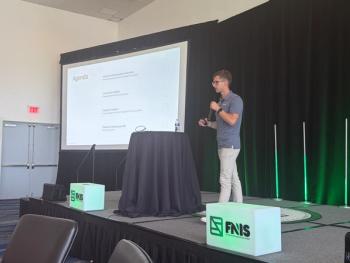
The Council for Responsible Nutrition (CRN) held its 2024 CONVERGENCE Conference October 9-11, in Salt Lake City, Utah. As part of the first day of the main sessions, Noelle Russell, Leading AI Innovator and Practitioner, founder and chief AI officer of AI Leadership Institute, presented, “The Future of AI in Your Industry.” In her hour-long deep dive, Russell explained the evolution of AI models and other emerging technology, and how to use AI responsibly as a tool, highlighting her work with Accenture, Microsoft, Amazon Alexa, and more. Using an analogy of adopting a baby tiger, she explained the importance of holding early conversations about the depth and breadth of AI’s capabilities in a workplace, including the potential for causing harm, while still embracing the transformative possibilities.
Russell encouraged companies to ask vital questions as they implement AI in their workplaces: “One, ‘where did this thing come from? Where did the data come from? How was it created?’ And then two, ‘what's the worst thing that could happen?’ Nobody wants to ask that at the beginning… The benefit of thinking about it early is that you have opportunity to actually mitigate the risks.” She provided first steps to take when implementing AI:
- Have a policy and a strategy
- Everyone in the company needs to be educated on AI, in order to recognize and understand it
- Build a mindset of being a Solution Architect willing to include AI as a tool for solutions, though without letting it become the decision maker
- Learn AI by building an AI system
The AI discussion continued in an hour-long discussion titled, “Applying AI Technologies to the Dietary Supplement Industry,” featuring panelists Noelle Russell, Akash Shah, Co-Founder/CEO, IngredientAI; Pelin Thorogood, Co-founder and Executive Chairwoman, Radicle Science; Jim Flatt, Co-founder & CEO, Brightseed; and Steve Mister, President and CEO, CRN.
The panelists explained how they each use AI in their businesses. Akash Shah described how his company used language models to filter and read through studies on ingredients. “The possibilities are endless in writing: safety dossier, raw materials specifications, all materials classifications, all kinds of things that are tedious and none of us like to do, it can do the reading and writing very quickly—this is just a really quick sneak peek into how we're helping the industry.”
Steve Mister brought up the concern of AI putting humans out of work, and Shah commented: “It's a tool. It's not a replacement. In our industry, it's my strong belief that humans won't be replaced, because, at the end of the day, what large language models are incredible at is reading and writing. But what AI sucks at is it has no intuition and it has no judgment, because it literally has no lived human experience. And so as a result, when we're making things that we're going to put into people's bodies to help them live healthier, there will always, in my opinion, be a human in the loop, because that judgment call AI is never going to be able to replace. If anything, I believe folks in this room are going to be able to get so much more done at the same amount of time, because now we can process so much more evidence.”
Next, Pelin Thorogood explained how AI-powered analytics transforms clinical trials, overcoming the traditional limitations. “We created a new category, ‘proof as a service,’ so we could generate evidence an unprecedented speed, affordability and scale, so that we can actually have access to those large, multi-dimensional data sets, both demographic and behavioral data sets, so we could actually treat those precision insights.” Using AI for the models helps “unlock personalization through data,” and identify the many factors that indicate a products’ effectiveness, which can inform R&D, optimize marketing, and enhance customer satisfaction, she explained. Thorogood also discussed how the scope of the data sets and machine learning protect against the development of “hallucinations.”
Finally, Jim Flatt explained the functions of the Forager AI technology platform: “to answer three key learning objectives that are central to the discovery and development of truly novel products that will deliver clinically proven health benefits that will be demonstrably superior to what's currently on the market.” AI is utilized in processing data from analytical instruments to gain insights into the compounds that make up dietary plants, botanical herbs, and microbes, to make more personalized products. AI can also predict the role of the compounds a priori through AI-trained models and from this they have identified over 40,000 bioactives that can provide the basis for new products covering over 23 health areas. He also described several of their case studies, one in particular involved working with Ocean Spray to identify several new compounds and components in their raw materials and final products.
The panelists closed out the discussion with final words on embracing the transformative advantages of AI to benefit the industry. “It’s a very, very powerful tool,” Thorogood stated. “And in this world where data is exploding everywhere, it's the only tool we have to make sense out of this expanding world. Old data, new data…The only way to make sense out of it is AI. So responsible use of it is not only going to enable us to drive precision wellness, which is the only way to optimize our health, but I also believe it's going to drive a healthier world. I couldn't be more excited. Again, it's what you do with it. So embrace it.”