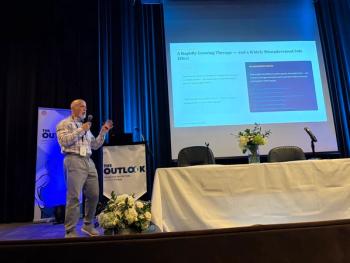
A panel at The Outlook on Active Nutrition discussed quality in sports nutrition focused on testing, liability, and what buyers now expect from suppliers.
Nutritional Outlook interviewed Ramasamy Venkatesh, managing director of Saanroo, about the company's Trpti OEA ingredient, which research has found to support GLP-1 secretion. Here, he explains the mechanisms behind OEA.
Sebastian Krawiec: So GLP-1 is obviously a very big trend right now. And you guys recently launched your Trpti OEA, which has been found in research to support natural GLP-1 production. I wonder if you'd kind of elaborate more on the mechanisms of action behind this ingredient.
Ramasamy Venkatesh: Oleoylethanolamide (OEA) is an endogenous fatty acid amide produced by your body, and it is produced in response to feeding. So, when you take food, your body converts oleic acid present in the body as a dietary saturated fat, into OEA, and OEA then binds to the G protein-coupled receptor 119, and enhances release of GLP-1. That's how GLP-1 is normally produced in the body. OEA is produced in the intestine, and the binding also happens in the intestine. When you're young, you're fine. Your microbiome is good. Your health is good. You can eat and drink what you want. You don't have issues related to sugar, related to GLP-1, obesity, anything, because your body is producing OEA, but as you age or due to pollution, the toxins in what you breathe, smoking, drinking, and eating processed food, and multiple other factors, your gut dysbiosis causes disruption in the production of OEA. And when OEA production is disrupted, GLP-1 release is affected. That's when you start seeing that for obese people, the body doesn't produce OEA, and you start seeing issues related to impaired glucose tolerance, as well as fat, and multiple other effects related to that. Trpti is the bioavailable form of OEA because there's a challenge in delivering OEA to the right place in the body, because OEA gets degraded in the gastrointestinal tract as well as in the intestines; it is hydrolyzed by fatty acid amide hydrolase. So, we worked on OEA with the LipiSperse delivery system of our partner and sister company Pharmako Biotechnologies to deliver OEA to the right places in the intestine where it can act upon and that has been the success of Trpti. We have done two clinical studies on it, and we have shown that GLP one levels went up as well as DPP-4 levels came down. DPP-4 is an enzyme which degrades GLP-1. So that's also a challenge. So this is the classical pathway by which your body works. What you're doing is giving back to your body what it does best in a bioavailable form. That's how Trpti works.