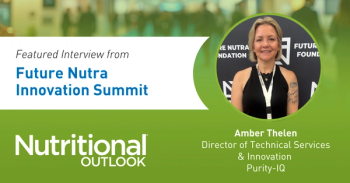
At the Future Nutra Innovation Summit, PLT Health's Steve Fink discusses joint, cognitive, and longevity nutrition explaining why "experiential longevity" is reshaping formulation strategy.
New systematic review and meta-analyses find that omega-3s, vitamin D, methylfolate, and S-adenosylmethionine (SAMe) may reduce depression symptoms when used in combination with antidepressant drugs.
Researchers at Harvard University (Cambridge, MA) and the University of Melbourne (Australia) have found that several popular dietary supplement ingredients, including EPA omega-3s, vitamin D, methylfolate, and S-adenosylmethionine (SAMe), may reduce symptoms of depression when used in combination with antidepressant drugs.
The new systematic review includes the results of 40 clinical trials of patients with clinical depression who were treated with nutraceuticals in addition to antidepressant drugs.
Aside from the aforementioned positive results of omega-3s, vitamin D, SAMe, and methylfolate, researchers also found positive isolated studies for creatine, folinic acid, and an amino acid combination at reducing depression symptoms in pairings with antidepressants. Zinc, folic acid, vitamin C, and tryptophan, on the other hand, showed mixed results for treating symptoms of depression.
Notably, omega-3s appeared to an especially effective ingredient for reducing depressive symptoms, as a meta-analysis comparing adjunctive omega-3 versus placebo “revealed a significant and moderate to strong effect in favor of omega-3.”
Researchers concluded: “Current evidence supports adjunctive use of SAMe, methylfolate, omega-3, and vitamin D with antidepressants to reduce depressive symptoms.”
The supplement ingredients that were found to be successful at reducing depression symptoms when combined with antidepressant medication are also known to have some antidepressant effect on their own, noted the Council for Responsible Nutrition (CRN; Washington, DC), which shared the study results.
Read more:
Michael Crane
Associate Editor
Nutritional Outlook Magazine
Sarris J et al., “Adjunctive nutraceuticals for depression: a systematic review and meta-analyses,” American Journal of Psychiatry, vol. 173, no. 6 (June 2016): 575–587